

Standing over a grill watching hot dogs roll around like sad little logs is a universal experience, and it does not have to be the whole story. The people who care most about this — and there are a startling number of them — have spent years arguing the finer points on r/BBQ, r/Cooking and r/Grilling, and a handful of techniques come up again and again until they stop being opinions and start being the way it is done.
None of this needs new equipment, exactly. Most of it needs about four extra minutes and a willingness to treat a hot dog like something worth cooking properly. Here is what actually survives the comment threads.
The Spiral Cut: More Surface Area, More Happiness
The technique that turns a smooth tube into something with edges, char and somewhere for the mustard to live.
Cutting a continuous spiral down the length of a hot dog before it hits the grill does three things at once. It opens up far more surface for browning, it gives the dog somewhere to expand instead of splitting, and it creates grooves that hold condiments rather than letting them slide straight off onto your shoe.
The method: run a skewer lengthwise through the center, then rest a knife against the dog at a shallow angle and rotate the skewer, letting the blade cut down to the skewer and no further. The skewer is the stop — that is the entire trick. Pull it out and the dog opens into an accordion on the heat.

Skewers
12-Inch Stainless Steel BBQ Skewers, 12-Pack
Any skewer works for the spiral cut, but a square-profile one works better than a round one: it grips the meat instead of spinning inside it while you rotate, which is exactly the moment the technique falls apart.
Twelve inches is longer than a hot dog needs, and that is the point — the extra length gives you something to hold that is nowhere near the blade. A twelve-pack also means you are not washing one between dogs while everyone waits.
Stainless rather than bamboo matters here because you are applying real lateral force. A soaked wooden skewer flexes under the knife and the spiral wanders.
Cast Iron: The Flat-Surface Argument
Grill purists will object. The case for cooking dogs on a solid surface instead of over open grates is better than it sounds.
A cast iron griddle sitting on the grates changes what you are cooking on without changing the heat source. Instead of char lines where the dog touches metal and nothing in between, you get even browning across the whole contact surface — the diner-counter result rather than the backyard one.
The practical advantages stack up quickly: nothing rolls into the fire, buns toast on the same surface at the same time, and onions can cook alongside in rendered fat instead of falling through. Heat retention also means the surface does not crash in temperature every time cold food lands on it.

Griddle
Lodge Pro-Grid Reversible Grill/Griddle, 20 × 10.5 in
Reversible is the feature that matters: ribbed on one side for grill marks, flat on the other for the griddle approach described above. You are not committing to one method when you buy it.
At 20 by 10.5 inches it spans two burners on a stovetop or sits across the grates of most kettle and gas grills, which means it is useful in January as well as July.
Bare cast iron, so it wants seasoning and does not want the dishwasher. In exchange it will outlast the grill you put it on, and it costs less than most nonstick pans that will not.
The Beer Bath: Cook Twice, Dry Out Never
Simmering before grilling sounds like a dorm-room shortcut. It is actually a two-stage cooking method with a real purpose.
The problem with grilling a hot dog from cold is that the outside has to sit over the fire long enough for the inside to heat through, and by then the casing has gone leathery. Bringing it up to temperature in liquid first means the grill only has to do one job: char the outside, fast.
Beer rather than water contributes a little malt and bitterness, and the simmering onions that usually go in with it come out soft and sweet and ready to pile on top. Use something cheap — the subtlety you paid for in a good beer does not survive the process. Five to ten minutes at a bare simmer is enough, then straight onto high heat for the color.

Saucepan
4-Quart Stainless Steel Saucepan with Lid
Four quarts is the useful size here — enough depth to submerge a full pack of dogs plus onions without the liquid boiling over when you add them cold.
Stainless with a lid means it can go on the side burner, on the grates themselves, or on the stove and then out to the grill, which is how this actually gets done at a cookout.
Nothing specialized about it, which is the point: this is the pan that already earns its keep, doing one more thing.
Bun Toasting: Thirty Seconds From Great to Ruined
The step people skip, then the step people burn. There is a narrow window and it closes fast.
A cold, soft bun undoes everything the grill just did. Toasting gives it structure, so it holds up to condiments instead of going to paste, and adds a layer of contrast against a soft interior. Butter or oil on the cut face, placed down on the heat, thirty seconds, done.
The failure mode is walking away. Bread over direct heat goes from pale to golden to carbon in well under a minute, and there is no recovering it. The other failure mode is grates: an open bun sags between them and toasts in stripes with raw bread in the gaps.

Grill topper
Outset Stainless Steel Grill Topper Grid, Set of 2
A perforated tray gives you a continuous surface over the fire, so buns toast evenly across the whole face instead of in grate stripes — and small things stop disappearing into the coals.
The set covers two sizes, 11 by 7 and 11 by 17 inches. The small one is for a few buns beside whatever else is cooking; the large one takes a full batch when you are feeding a crowd.
Handles on both, which sounds minor until you are moving a tray of hot bread off direct heat with one hand. Perforated stainless also means smoke still reaches the food — this is a surface, not a pan.
Topping Creativity: Past the Ketchup Argument
The ketchup-versus-mustard fight is the least interesting thing happening in these threads. The regional stuff is where it gets good.
Hot dog toppings are one of the few areas where the internet reliably produces something better than the default. The combinations that come up most often are not random — most of them are regional traditions that escaped their city of origin.
- Chicago — yellow mustard, neon relish, onion, tomato, sport peppers, celery salt, pickle spear. No ketchup, as the entire city will tell you.
- Sonoran — bacon-wrapped, pinto beans, onion, tomato, mayo, mustard, jalapeño salsa.
- Coney — all-meat chili, yellow mustard, diced white onion.
- Seattle — cream cheese and grilled onions, which sounds wrong and is not.
- Slaw dog — chili and vinegar coleslaw, Carolinas-style.
- Kimchi and scallion — the one that shows up most often in the “try this” replies.
The other recurring piece of advice is structural rather than culinary: set the toppings out and let people build their own. It removes you from the assembly line and it turns out to be most of the entertainment.

Squeeze bottles
Norcalway 12 oz Condiment Squeeze Bottles, 3-Pack
Decanting into squeeze bottles is the difference between a toppings table and a cluttered counter. Three bottles covers mustard, ketchup and whatever third sauce you are pushing this year.
Twelve ounces each is enough for a party without being so large they tip. The narrow tips give you a controlled line down the dog rather than a blob.
They also take house-made sauces, which is the actual argument for them — a thinned chipotle mayo or a garlic aioli has nowhere else to live on a table like this.
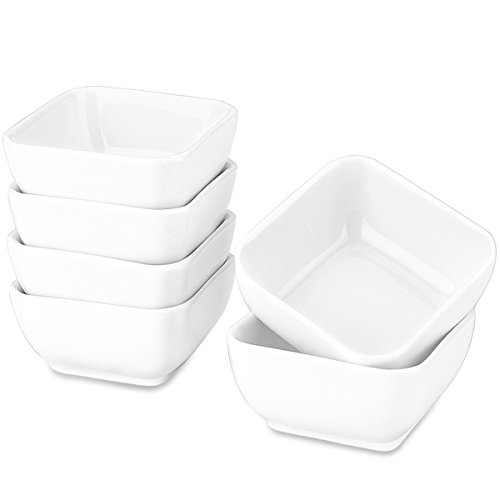
Serving bowls
DELLING 3 oz Ceramic Dipping Bowls, Set of 6
Six small bowls is the right number for a toppings spread: relish, onion, sport peppers, jalapeños, slaw, cheese. Enough variety that people make real choices.
Ceramic rather than plastic matters more than it should here. It stays put when people are spooning out of it one-handed, and it does not blow off the table.
Three ounces each keeps portions sensible and the table compact. They stack, and they go in the dishwasher, which is the whole reason they get used again.
The Sacred Rules
The rapid-fire advice that turns up in nearly every thread, usually stated as though disagreeing were not an option.
- Do not poke holes in them. Every puncture is juice leaving. This is the one people are most emphatic about.
- Turn them often. A quarter turn every thirty seconds or so. Leaving one side down long enough to get color means the other three are drying out.
- Buy natural casing. This is the single biggest upgrade available, and it costs almost nothing. The snap is the casing.
- Keep a cool zone. Somewhere to park dogs that are done while the rest catch up, without cooking them further.
- Medium heat, not maximum. They are already cooked. You are browning, not cooking through, and high heat splits them.
- Toast the bun. It appears in every thread and it is still the step most often skipped.
One thing worth saying
Most of these techniques overlap rather than compete. The beer bath and the cast iron griddle work together, the spiral cut is better on a flat surface than over grates, and bun toasting belongs in all of them. Start with the spiral cut and natural casing dogs, which are the two cheapest changes with the largest return, and add the rest as you go.
None of this is complicated and none of it takes equipment you would only use once a year. Four extra minutes and a little attention is the whole investment, and the gap between a hot dog cooked properly and one rolled around on the grates until it looks done is much wider than it has any right to be.
FAQ
Can I grill frozen hot dogs straight from the freezer?
You can, but the result is a charred outside and a cold middle. Thaw them first, or use the beer bath method above, which brings them up to temperature gently before they ever see direct heat.
What is the deal with natural casing hot dogs?
The casing is what produces the snap when you bite down. Skinless dogs are made in a casing that is stripped off before packaging, so there is nothing left to resist. It is the most noticeable difference between a cheap dog and a good one.
Aluminum foil with hot dogs: hero or villain?
Useful if you are worried about losing them through the grates, but you trade away char and grill marks for that safety. A perforated grill topper solves the same problem without the trade.
How do I keep grilled hot dogs warm for a crowd?
Keep them in the simmering liquid from the beer bath, off direct heat, or wrap in foil in a low oven. Either way do not hold them too long — the texture goes wrinkled and the casing loses its snap.
Are there healthier hot dog options that actually taste good?
Turkey dogs and the better veggie brands hold up fine, but both have less fat, so they dry out faster. Shorten the cooking time and keep them over indirect heat for most of it.